

Three generations, two villages, one family’s mountain.
Faustine Armand, sales manager of La Maison Pinturault, met me with a smile outside Hôtel Les Peupliers on a lovely afternoon, the kind where the mountains begin to disappear into the clouds and the village turns inward. I instantly could tell that she was the right person to introduce me to a place like this. She’s been working in Courchevel for 14 years, skiing, mountain biking, embedded in the local community long before she joined La Maison a year ago, and I recognized her mountain smile from the ski towns I’ve lived in in Colorado over the last 30 years, warm without being performative, genuinely proud of Le Praz and of the family whose story she was about to share with me.
We toured the village, past the ski jumps, the Épicerie du Praz, down the alleyway to the old stable that is now L’Étable des Lys with the easy familiarity of someone who loves where they work.

After squeezing out of my helmet and ski boots, we lunched at La Table de Mon Grand-Père, and the food was exactly what is demanded after a morning shredding high speed groomers and tentatively testing the off-piste of Courchevel…generous, local, hearty. By the time we finished I was already thinking about coming back with my bike. That feeling, I’ve come to understand, is the whole point.
The gondola from Le Praz deposits you at the edge of snow in Courchevel 1850 in just about seven minutes, part of the village transportation infrastructure in fact. Up top is what most people picture when they hear the name — and the altiport made famous from the 2025 Tour de France finish, designer boutiques, five-star addresses and discotheques perched above the snowline.
Below, however, is a real village, one that was here before the ski lifts, where schoolchildren walk down the streets in the morning and year-round residents keep gardens and shop locally. Le Praz is where Courchevel’s roots are, and not coincidentally, where the Pinturault family story is alive.
The Pinturaults arrived in Courchevel in 1961, when the ski area was still finding itself. Christiane and André had the pioneering sense to build their hotel Annapurna in 1974, and it has held the highest address in the resort ever since, awarded a Michelin Key, and also ski-in/ski-out onto the Pralong lift. In 2022, the family extended their reach down the mountain to acquire Hôtel Les Peupliers in Le Praz, a historic property that has changed hands only twice in nearly a century. Together along with three private chalets in the forest above Le Praz, and a collection of restaurants across these villages, La Maison Pinturault now spans the full vertical and cultural range of the resort, from the summit to the valley floor, in a way that mirrors the family’s own breadth of connection to this place.
This is not a hospitality brand that materialized from a business plan; it is a family that has been skiing, cooking, farming, and hosting on this mountain for more than 60 years.

The Mountain They Know
If you are the kind of skier for whom Les 3 Vallées is not an aspiration but a pilgrimage, you already know what this terrain means. Six hundred kilometers of linked slopes connecting Courchevel, Méribel, Val Thorens, Saint-Martin-de-Belleville, Les Menuires, Brides-les-Bains, and Orelle — the largest ski area in the world, with 150 kilometers in Courchevel alone. The Annapurna sits directly on the slopes with access to a beginners’ area right out the door, so families with mixed abilities can all get on the hill without a production. For stronger skiers, the demanding summits and the full Les 3 Vallées circuit are a lift ride away.

The Pinturaults did not simply set up shop at the entrance to all of this, they grew up in it, which is why Alexis Pinturault’s story feels less like a footnote to the family hospitality business and more like its spiritual center. Three-time World Champion and three-time Olympic medalist: two bronzes in the giant slalom, a silver in combined. Five small crystal globes and the large one, the overall World Cup title, which only Jean-Claude Killy and Luc Alphand had won before him in French skiing history. The most decorated alpine ski racer France has ever produced, he learned to ski on these slopes, coming back to these mountains at the end of every season, and is now building his post-racing life here with his wife Romane. Their daughter Olympe arrived last year, the fourth generation.

His trophies line the walls of La Table de Mon Grand-Père in Le Praz…a genuine record of a life lived thoroughly on this mountain. He and Romane are expected to take over the Courchevel Le Praz properties when his racing career winds down. The Chalets Altaï (three eco-designed private chalets in the forest above Le Praz) were built in 2023 in part through his involvement. When serious skiers sit down to dinner in Le Praz and look at those trophies, they know exactly what they mean.

His sister Sandra runs the collection. She joined the Annapurna in 2013, starting as a receptionist, working through reception management and accommodations before taking over the hotel in 2019. By 2022 she had created three restaurants, including the gastronomic Alpage, which earned a Michelin star in its first season, as well as the Écotable label’s highest three-star distinction for sustainable gastronomy. Sandra is a passionate equestrian and art collector, and those sensibilities show throughout the Annapurna, fine art photography on the walls, street art she champions, room renovations in light oak and natural wool that feel intended for those who spend their summers outdoors. Since December 2023 she has helmed the full La Maison Pinturault Collection across both villages.

Le Praz: The Village First
Arriving in Courchevel, you’ll first discover Le Praz village at 1,300 meters, at the edge of the forest at Lac du Praz, facing the 1992 Olympic ski jump complex. The streets are narrow, the buildings representative of southern France, with local residents here who are not on vacation. The gondola to 1850 runs regularly to ensure a connection to the slopes above and easy access to the sport; but the pace and feeling are entirely different.
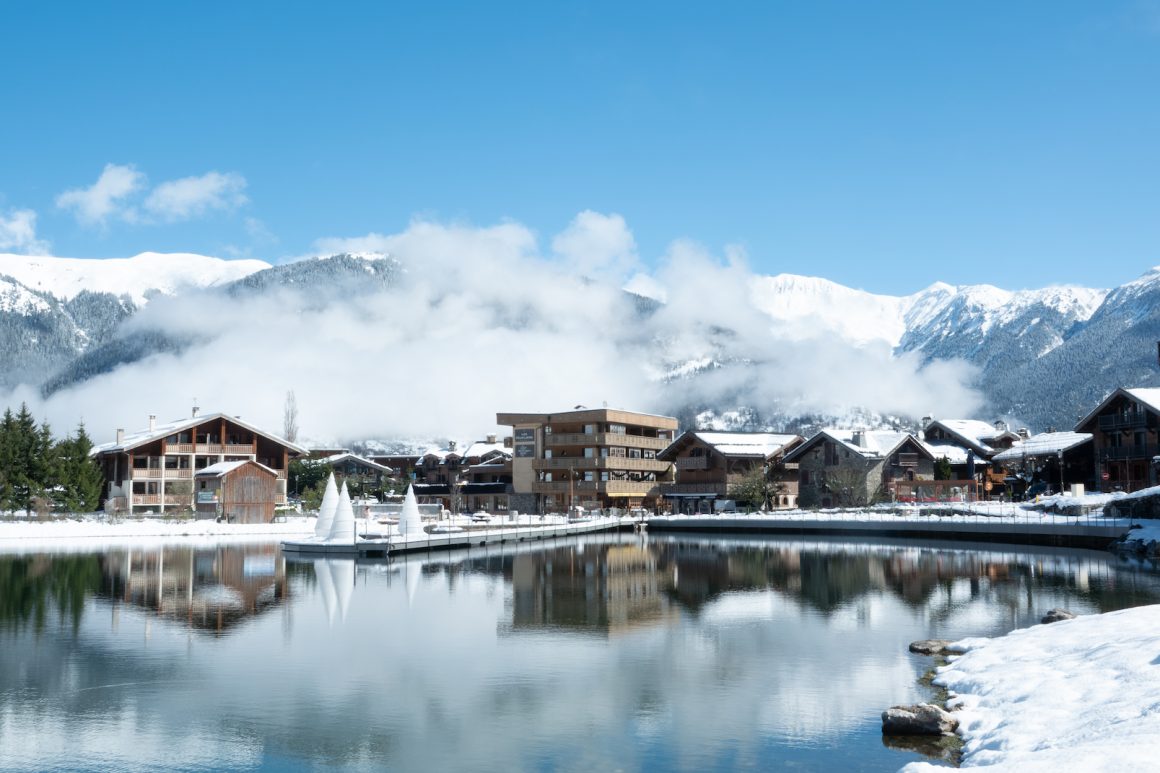
Hôtel Les Peupliers seems to anchor the village. Built by the Blanc family in 1930, taken over by the Gacon family in 1980, and purchased by the Pinturaults in 2022, only the third family to own it in nearly a century. It’s a four-star property that wears its history comfortably: a lakefront address with a south-facing terrace and the feel of a house that has always belonged to the same person. It features 18 rooms and suites in the main building, finished in stone and wood with Savoyard motifs and views of the village and lake. Across the street, a 14-room annex called La Maison sits just meters from Lac du Praz. General Manager Julien Chamoux has been here since 2023, a family friend and former Accor and Cimalpes veteran who chose Le Praz for its own sake: “the family atmosphere and the village life all year-round, where schoolchildren pass skiers in the morning.”

La Table de Mon Grand-Père is where Le Praz’s culinary soul lives. The kitchen is run by Chef Maxime Bertholle under the direction of Jean-Rémi Caillon — local, seasonal, quintessential French. Caillon describes it simply: “We dine as we gather after a day outdoors, with fresh cheeks, open hearts and hearty appetites. A mountain on a human scale.” Seasonal stews, matured cuts of beef, freshwater fish, vegetables from local growers, Trufflifette and Crozotto. Get the sharing menu. (Live music runs every first Thursday of the month.)
Tucked down a charming village alleyway, L’Étable des Lys occupies a former village stable under stone vaults decorated with old wood. Although it was closed for a private event that evening, I was told cheeses selected by Bernard Mure-Ravaud, a Meilleur Ouvrier de France, drawn from nearby farms — potchon, matouille — in a setting Caillon describes with obvious affection: “You enter as if in a friend’s house. The wood creaks, the embers crackle, and the cheese warms you.” Out front, the Kiosque does crêpes, waffles, and mulled wine. L’Épicerie du Praz, opposite the hotel and curated by grocer Thierry, stocks the same products used across La Maison’s kitchens…bread from La Marmottine, Savoyard charcuterie, fine wines, crozets, specialty coffees, plus signature items like the artisanal La Mousse du Chef beer (which I enjoyed thoroughly) and the La Maison Pinturault house coffee (which I also enjoyed upon my sad return to the United States). Their gourmet events series, Les Rencontres Gourmandes, is in its second season, bringing winemakers, cheesemakers, growers, and chocolatiers in for evenings that feel more like village life than programming.
Into the Forest: Chalets Altaï
Hidden at the end of a small alleyway leading into the forest above Le Praz, the three Chalets Altaï were completed in 2023, built by Sandra and Alexis as a statement about what responsible alpine architecture can look like. Named for a Eurasian mountain range spanning Russia, Mongolia, China, and Kazakhstan, they were constructed with eco-responsible materials, wood heating, triple glazing, thermo-brushed local wood, natural wool and regional stone, and furnished with vintage designer pieces sourced through the Selency marketplace by Atelier Giffon. Every detail, from ski pole handles in the ski room to the carefully chosen books and dishes, feels like the work of people who use these spaces.
Chalet Beloukha runs 430 square meters, sleeps eight adults and four children across four double bedrooms and a children’s dormitory with its own slide, and is ski-in. Chalet Irbis (named for the snow leopard) is a five-bedroom retreat for ten, with hammam (Turkish bath), sauna, and herbal tea room. Chalet Khoton is the flagship: 506 square meters, five bedrooms, and a 120-square-meter spa with an indoor pool, Japanese baths, hammam, sauna, a Norwegian sauna, massage room running Estime & Sens treatments, and a gym. All three receive full Hôtel Les Peupliers hotel services: shuttles, daily housekeeping, breakfast, and concierge (and access to the Estime & Sens spa). I didn’t get to tour these properties but from what I can tell, I really want to go and live there, forever.
Hôtel Annapurna: The Summit
The Annapurna sits at 1850 between the Jardin Alpin and the altiport, ski-in/ski-out onto the Pralong lift and into Les 3 Vallées. Christiane and André Pinturault acquired the land in 1972 and opened the hotel two years later. Claude modernized it through the 1980s, adding suites, terraces, the heated outdoor pool, spa, and a seminar room. Sandra has continued that evolution since 2019, renovating rooms and restaurants through 2023 without disturbing what her grandparents built. What they built, was soul.

The building was designed on the heliotropic principle, oriented to chase the sun across its exposures so the panoramic views of La Saulire, La Grande Casse, and L’Aiguille du Fruit are never static, light moves through the giant bay windows differently depending on your floor and the hour. Luxury on a human scale, the Pinturaults call it, authentic, warm, without the coldness that high-end alpine addresses can carry.
This winter brings significant updates. Four Junior Suites and the flagship Everest Suite (145 square meters, a terrace facing the slopes, a private sauna) have been redesigned by Atelier Giffon in light oak, wool, and natural stone. “Every year we undertake hotel renovations,” Sandra said, “incorporating wood, stone and natural colors.” The 76 rooms and suites span five categories, from compact Vallée rooms to the named suites — Annapurna, Makalu, K2 — borrowing scale from the 8,000-meter peaks they’re named for.

The spa has been redesigned this season too: more spacious hammam, new jacuzzi facing the mountains, two saunas including one with panoramic views, both indoor 15-meter and outdoor pools, and Codage treatment rooms where custom serums are formulated on-site for each guest, along with yoga, Pilates, physiotherapy, and osteopathy. For families, La Banquise des Petits handles kids three to ten with an indoor polar-themed club and a Base Camp outdoor playground including a real igloo, 21-meter slide, and fishing module. A teen room and screening room handle the rest.
The ski service is dialed: heated individual lockers, ski valet, and shop on site. A fleet of hybrid Range Rovers handles village transport…40 years of refinement look like this.
The Kitchen at the Heart of It All
Jean-Rémi Caillon is the culinary thread running through every La Maison Pinturault address. A native of Roanne who has worked on the Côte d’Azur, in Paris, and at Lake Geneva, he carries Bocuse and Escoffier alongside lessons from his travels in Japan and a love of foraging for wild herbs.
“While meat and fish remain central to my cooking,” he says, “it is essential that we give vegetables their due, ensuring that they make up at least 50 percent of the plate at every meal.” That holds across every kitchen in the collection.
At Alpage (18 seats Wednesday through Sunday evenings, one Michelin star) five and seven-course menus pay tribute to the surrounding mountains through the artisans, market gardeners, and producers of the valley. The dining room feels like a distillation of the landscape: oak from Albertville, granite from the Mont Blanc massif, ceramics by Anne Marmottan, a soundscape by Le Couturier du Son. The three Écotable macarons — the label’s highest distinction — reflect Caillon and Sandra’s rigorous commitment to local sourcing and ecological responsibility.

Restaurant La Table de l’Annapurna, the Annapurna’s main dining room, serves generous traditional French cuisine with a sunny terrace at the edge of the slopes. Head sommelier Valentin Peyrard runs weekly winemaker dinners featuring producers from Champagne, Burgundy, the Loire, Bordeaux, the Savoie, and the Côtes du Rhône, older vintages and menus from Caillon’s kitchen, roughly three hours of genuine food-and-wine immersion. (Weekly tasting workshops for four to ten guests run at €40 per person.)
La Fèrma, the hotel’s 20-seat Savoyard specialist, is where you come for raclette and fondue while the snow falls outside — cheeses selected by Bernard Mure-Ravaud, a Meilleur Ouvrier de France. The bar, where Alain Péant has been making cocktails for 40 years and this season welcomes original creations from French mixologist Jérémy LeBlanche of New York’s Thyme Bar, is the kind of room where the evening extends without asking permission.
Courchevel celebrates its 80th anniversary this season. The resort hosted the women’s slalom World Cup in December 2025 and will host the men’s super-G and downhill in March 2026. The Alps may host the 2030 Olympics, with Courchevel in the running for events. These are indications of a mountain that matters to the world.
The Pinturaults have been part of that mountain since before most of its visitors were born. Their family motto — “le partage en héritage, sharing as heritage” — may sound cliche in English, but happens to be true. What La Maison Pinturault offers across the Annapurna at 1850 and the properties in Le Praz is not a curated lifestyle product, but three generations who live, ski, cook here, and have staked their family’s identity on this particular place and have been welcoming guests into that story for more than 50 years. The fourth generation arrived last year and the mountain isn’t going anywhere.
La Maison Pinturault: Hôtel Annapurna and restaurants open December 12 to April 12, 2026. Hôtel Les Peupliers and L’Épicerie du Praz open November 3 to April 19, 2026. Photos courtesy of the property.

–Author Aaron H. Bible is an award-winning travel and outdoors writer with more than 30 years experience covering the outdoor lifestyle industry. Follow him @DefinitelyWild.
