

The Chaliapin Steak on the menu at the Imperial Hotel, Tokyo, Japan, has been there since 1934.
Not a version of it, or a modern interpretation…the same steak made the same way for the reason it was curated perfectly in the first place…allegedly because a certain Russian opera singer couldn’t chew.
Feodor Chaliapin was in Tokyo for a performance when he complained that the beef was too tough. The hotel’s kitchen responded by tenderizing the cut with grated onion, whose enzymes break down muscle fiber until the meat yields without resistance, then finished it with sautéed onions in place of a traditional sauce. The Chaliapin Steak has been on the menu ever since, a dish born from a single guest’s complaint that is now nearly a century old. The Imperial is not a hotel that trades on history as an aesthetic. It’s one where history never stopped being made.
Opened in 1890 as a state guesthouse for international visitors, the Imperial occupies a particular position in Tokyo’s cultural life. Situated in Hibiya, near the Imperial Palace and Ginza, it has served as the setting for diplomatic visits, cultural exchanges, and quiet transactions between Japan and the world for more than 135 years. Frank Lloyd Wright designed its second iteration, completed in 1923, and that building survived the Great Kantō Earthquake the same year, a fact that reinforced the hotel’s reputation for a structural seriousness that extended well beyond architecture. The dining rooms inherited that same disposition. Where other institutions reconstruct the past for atmosphere, the Imperial simply never let it go.
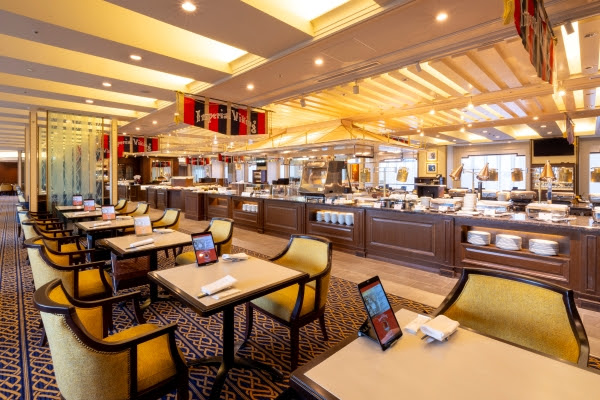
In 1958, Imperial Hotel president Tetsuzō Inumaru returned from Scandinavia having encountered the smorgasbord and adapted the format for a Japanese audience. The resulting restaurant, the Imperial Viking Sal, became Japan’s first buffet of its kind. The name stuck so thoroughly that “Viking” entered everyday Japanese as a synonym for all-you-can-eat buffet dining, a piece of common language with a traceable origin point in a single hotel in postwar Tokyo. Renewed in August 2023, the Viking Sal now presents more than 50 dishes spanning French, Japanese, and Chinese influences, but the format remains what it always was: a meal you build yourself, moving between cuisines and eras plate by plate, without a fixed progression telling you what comes next. A single visit can trace prewar European technique into postwar Japanese adaptation into something that reads as fully contemporary, in whatever order you want to experience it.
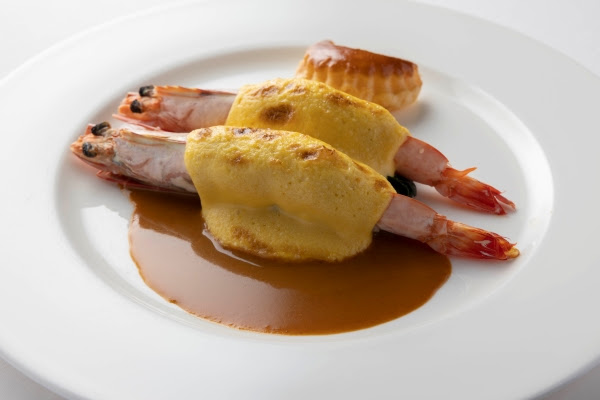
The dishes that anchor the room tell you where you are in time. The Gratin of Prawn and Sole “Queen Elizabeth II” was first prepared in 1975, during the Queen’s state visit to Japan. Delicate seafood in a carefully balanced cream preparation, designed for the restrained register of diplomatic hospitality, it carries the Queen’s name with her approval and has been on the menu ever since. The hotel’s Signature Double Consommé Soup takes a different approach to history, carrying no famous origin story but instead reflecting the introduction and long refinement of classical French technique within Japan. Achieving its clarity requires prolonged clarification that removes impurities while concentrating flavor into a crystal-clear broth that has served as a benchmark of the kitchen’s technical standards across generations.
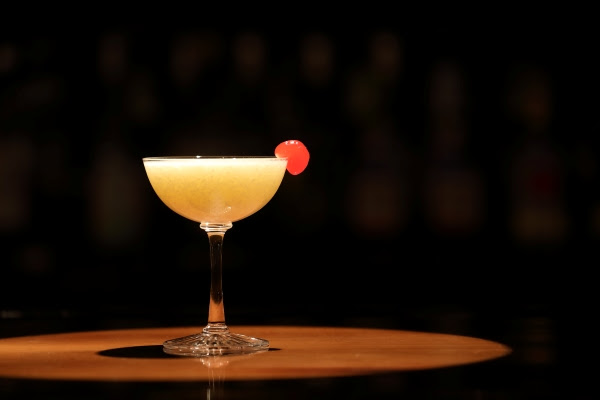
Then there is the Mount Fuji cocktail, first mixed in 1924 at what is now the Old Imperial Bar. Created as a welcome drink for Western passengers arriving on around-the-world cruises, it was built as an image: gin, fruit juices, egg white, and cream producing a white foamy surface with a maraschino cherry at the center, a snow-capped mountain with the red sun rising above it. The identity of its original creator has been lost, but the recipe has not changed, and it is served today exactly as it was a hundred years ago to people stepping off a ship with no prior picture of what Japan looked like.
The dishes stayed because they were good, because guests kept ordering them, because the kitchen kept making them correctly across generation after generation of cooks. When you sit down at the Imperial, you are eating meals that people ate years before: Chaliapin in 1934, the Queen’s delegation in 1975, a cruise passenger in 1924 encountering Japan for the first time through a glass. The hotel held onto all of it, and it is still here.
